

Exhibition of works created by the “guests” of the Centre Speranza – Albert II of Monaco
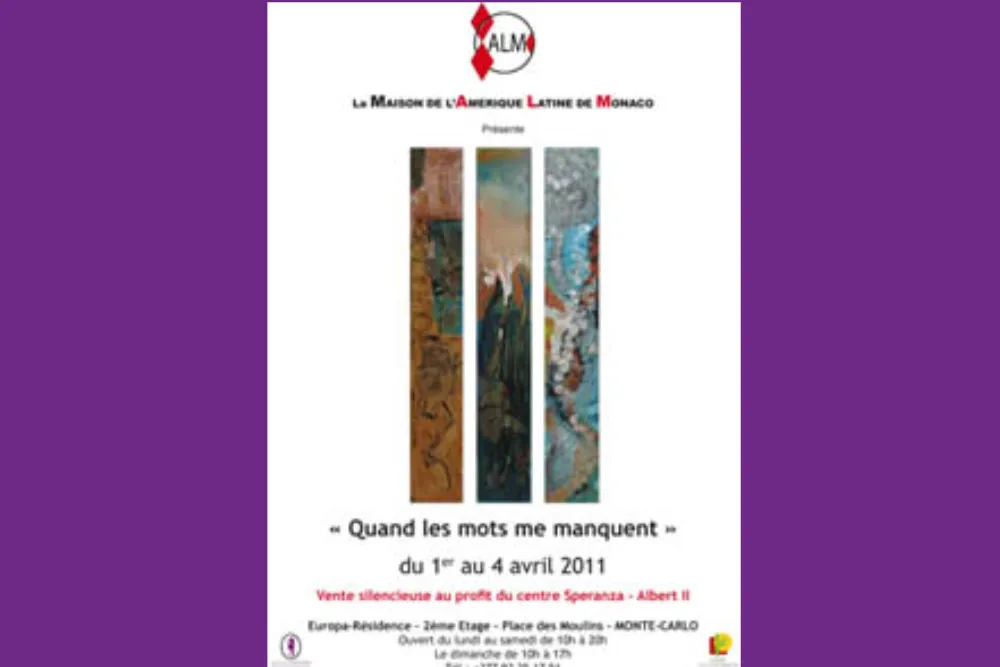
 As part of the “ART and ALZHEIMER 2011” initiative, the AMPA (Monaco Association for Alzheimer’s) and the day-care center at the Centre Speranza – Albert II of Monaco organized an exhibition titled “When Words Fail Me” (*Quand les mots me manquent*), held in conjunction with the *Printemps des Arts* (Spring of the Arts) festival in Monte-Carlo.
For the first time in Monaco, over twenty paintings—created during group workshops by individuals living with the disease—were exhibited from April 1 to 4, 2011, at the *Maison de l’Amérique Latine* (House of Latin America). The works were discussed by gallery owner Pierre Carron during the opening reception, which provided an opportunity for patients, their families, staff, and the general public to engage with one another.
This project is the result of remarkable work carried out by the team at the Centre Speranza. As the center’s coordinator, Philippe Migliasso, explains, the process required “engaging with the individual’s environment, providing reassurance, supporting sometimes hesitant movements, and encouraging a sense of letting go—all while ensuring that each person retained their freedom of expression.”
Alzheimer’s: When creativity is brought into the light
Would you look at these works differently if you were told they had been created by people living with Alzheimer’s disease? This was one of the questions raised by the group exhibition “When Words Fail Me” (*Quand les mots me manquent*).
Organizing artistic expression workshops is a common practice in care facilities for dependent elderly people. It must be noted, however, that the works created often remain within these facilities, with few opportunities to be seen by the general public.
The originality of this project lay in treating this exhibition just like any other art show: selecting a recognized exhibition venue, opening it to the general public, hosting an opening reception, providing commentary in the presence of the “artists” and their families, producing a catalog, and selling the paintings (with proceeds benefiting a collective project for the residents).
Bringing the creativity of people living with Alzheimer’s disease out from behind the walls of the care facility, giving these works a place in the wider community, and shifting the public’s perception of the disease—these were the core objectives of the exhibition.
Indeed, the brushwork appears controlled, the composition thoughtful, the technique deliberate, the colors intentional, the intensity purposeful, and the aesthetic quality clear. And yet, beyond the quality of the pieces themselves, these paintings provoke questions: Is this Art? What artistic value should be assigned to these works? Does Alzheimer’s disease stifle creativity, or does it, conversely, amplify it? Emotions, inquiries, reflections—isn’t that what Art is all about?
View the exhibition booklet here: Exhibition Booklet